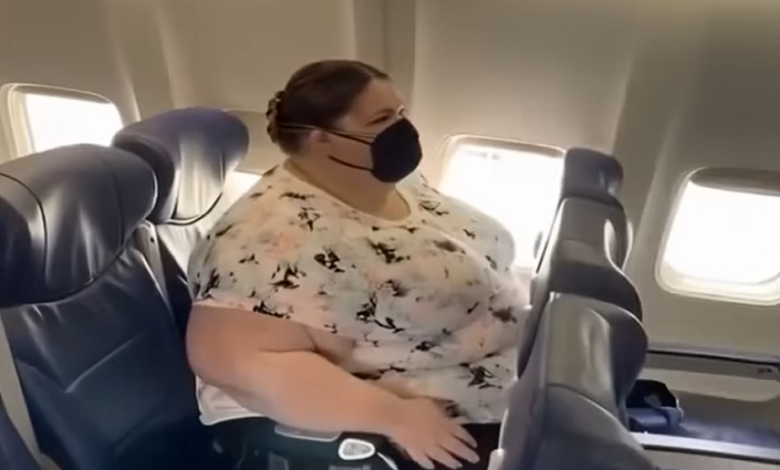
The woman glared at me with pure, unadulterated hatred as she shoved her young child into the seat beside me. I had legally purchased, paid for, and secured that spot with my own hard-earned money, yet in her eyes, I was a selfish monster stealing precious space from an innocent toddler. The tension in the cabin was thick enough to choke on, and every whisper from surrounding passengers felt like a dagger against my skin. How had I, a paying customer simply trying to survive a flight, become the villain in a drama I never wanted to star in?
Air travel is marketed as a routine, almost mundane part of modern life, but for those of us who carry more weight than the average traveler, it is a constant, high-stakes battleground. Most people simply walk down the aisle, find their row, and settle in with a sigh of relief. For me, that same walk is a journey of anxiety. Will my body fit? Will I be the person who causes another passenger physical discomfort? Will I be subjected to the rolling eyes, the heavy sighs, or the whispered, venomous comments that imply my very existence in a public space is an imposition?
Over the years, I have developed a survival strategy to navigate this systemic nightmare. It is not a choice made out of luxury or a desire for special treatment. It is a calculated, pragmatic decision to protect my dignity and ensure that I do not inadvertently disrupt the peace of my fellow passengers. My solution is simple but costly: I purchase two airplane seats for every flight I take.
The reality of modern aviation is that it has become increasingly hostile to anyone who does not fit into a very narrow, industry-defined mold. Economy class seats are rarely wider than 17 or 18 inches. These dimensions were not created with human comfort as the primary goal; they were engineered for maximum capacity and profit. For a person of my size, this architecture is not just restrictive—it is often physically painful. Beyond the crushing pressure on my own frame, there is the persistent, gnawing stress of knowing that my body might naturally cross that invisible, sacred line into the seat next to me.
For years, I lived in a state of constant, exhausting tension. Every flight was an endurance test. I spent hours rigid, pulling my arms in, hunching my shoulders, and meticulously calculating how to minimize my footprint. I couldn’t read, I couldn’t sleep, and I couldn’t even breathe deeply without the fear of causing a conflict. It felt as though I were apologizing for taking up space in the world. Eventually, I reached a breaking point. I decided that no price was too high for the ability to exist without shame. I began buying two seats: one for myself and one as a buffer.
This change transformed the way I travel. With that extra bit of breathing room, I could finally manage my personal items, relax my muscles, and exist without the constant, draining fear of being a nuisance to my neighbor. It allowed me to reclaim my autonomy.
However, even the most meticulous planning cannot account for the sheer unpredictability of other human beings. On my most recent flight, I arrived at my row—a window seat and the adjoining seat I had paid for—only to find a mother already attempting to claim the space for her young child. I was stunned. I stood there, heart pounding, trying to find the right words to address a situation that should never have happened.
My instinct was to panic, to apologize, or to simply let it go and suffer through the flight to avoid a confrontation. But I remembered why I bought the second seat. It wasn’t a whim; it was a necessity. I spoke firmly but calmly, explaining that I had purchased both tickets for my own personal needs. The response was immediate and hostile. She raised her voice, accusing me of being unfair and heartless for denying her child a seat while I sat in “extra” space. The cabin, previously quiet, suddenly felt like a stage. Glances darted in our direction, and the air crackled with judgment.
I held my ground, not out of malice, but out of necessity. I understood her frustration—traveling with a child is inherently stressful—but her stress did not invalidate my contract with the airline. I repeated my position, maintained my composure, and eventually had to summon a flight attendant. Having to produce proof of purchase felt degrading, like I was defending my right to exist, but the attendant was professional. They explained the policy to the mother, and she eventually relocated her child.
That moment of relief was bittersweet. It confirmed that even when you take every precaution, you are still at the mercy of a world that refuses to accommodate bodies like mine. It underscored a brutal truth: commercial aviation is failing its passengers. We are forced to pay a “fat tax” just to avoid the indignity of being treated like an obstacle.
For anyone who finds themselves in this situation, I offer this: advocate for yourself with the same level of care you use to plan your itinerary. Choose your airlines, select your aircraft, and if you can afford it, secure that second seat. Do not apologize for the space you take up. We live in a society that often prioritizes efficiency over empathy, but your dignity is not up for negotiation.
Air travel is, in many ways, a microcosm of our broader world. We are all jammed together, rushing toward our own destinations, often too caught up in our own stress to notice the humanity of the person sitting next to us. By preparing ahead, keeping our cool, and setting firm but respectful boundaries, we can navigate these confined spaces without losing our self-worth. Purchasing that extra seat is not about indulgence. It is a radical act of self-preservation. It is the simple, powerful, and necessary assertion that everyone, regardless of their size, deserves to move through the world with comfort, privacy, and, above all, dignity.
