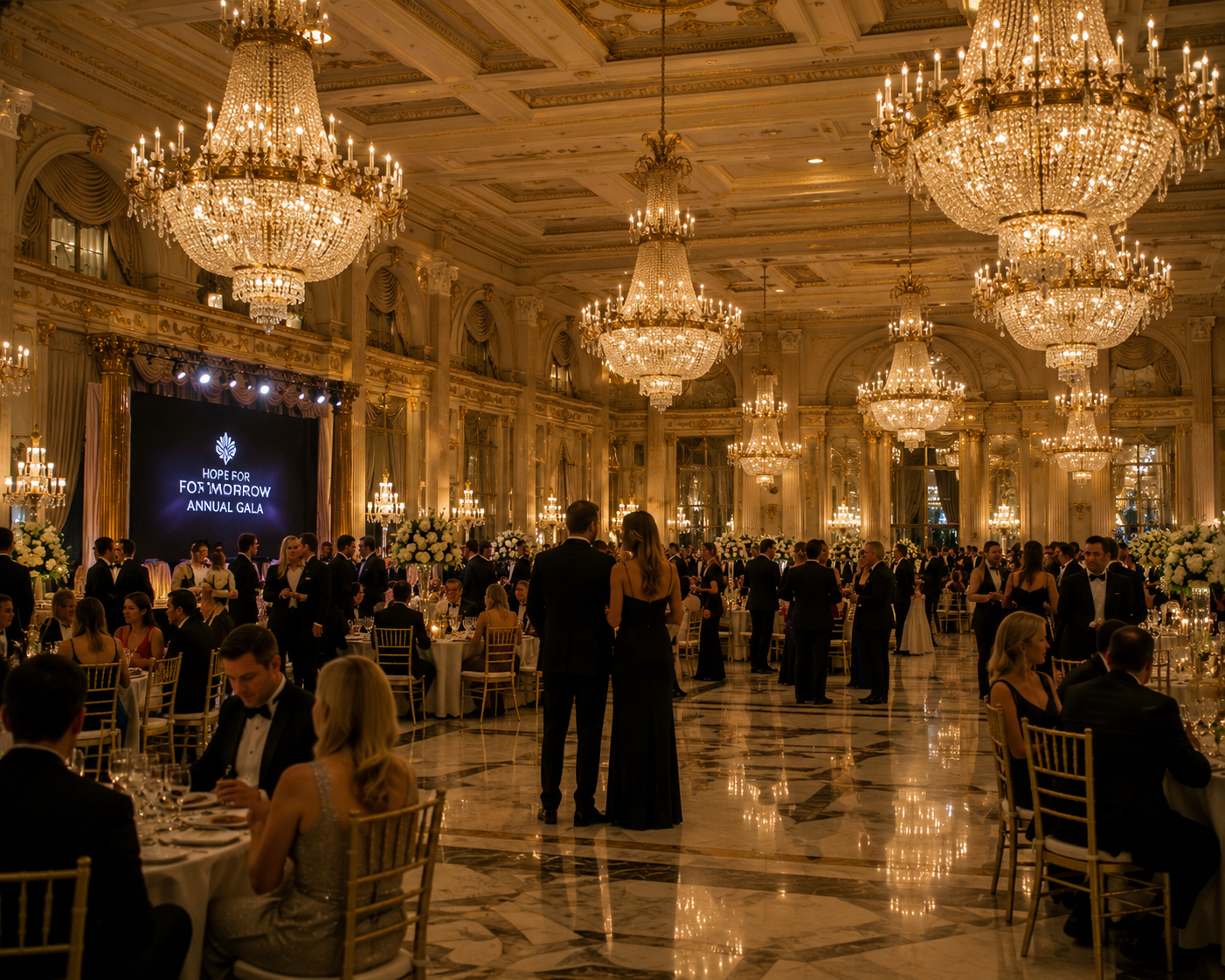
The gala was called the Hartwell Foundation Evening.
It occurred annually in the Grand Soleil Ballroom of the Meridian Hotel, which occupied the top three floors of a tower in the financial district and existed, architecturally and philosophically, to make the people inside it feel that they had arrived at the correct destination. The ballroom had crystal chandeliers that cast light in the particular way of things that cost more than most people earn in a year. The chairs were gold. The tables were dressed in white linen that had been pressed that morning by a woman whose name no one at the event would learn. The marble floors reflected everything — the chandeliers, the guests, the careful geometry of a room designed to show wealth the most flattering version of itself.
There were three hundred and forty people in attendance.
One of them was Daniel Hartwell.
Daniel Hartwell was forty-four years old and he had built the thing that bore his name from a single office and a borrowed desk and the specific quality of intelligence that does not wait for permission. He had grown it over twenty years into something that employed eight hundred people and contributed, through its charitable arm, to causes he selected with the same precision he applied to everything — not with sentiment, not with impulse, but with the cold clarity of a man who had decided that effectiveness was a form of morality and waste was its opposite.
He was good at this.
He had been told he was good at this many times, by many people, in the particular tone of a compliment that has been given so often it has begun to function as a description rather than a praise.
He stood near the bar with a glass of something he didn’t particularly want and talked to people he knew well enough to talk to at events like this, and he performed the version of himself that events like this required — present, engaged, warm in the specifically calibrated way of someone who understands that warmth is an asset and has learned to deploy it.
He had not thought about Sofia in three years.
He would think about her tonight.
Sofia Reyes had worked for the catering company for four years.
She was twenty-six years old and she had come from the part of the city that was not the part where the Meridian Hotel was located, and she had taken the catering work because it paid more than the other options available to her and the hours were compatible with the other thing her life required, which was her son.
Her son’s name was Marco.
He was three years old.
He had his mother’s eyes and a quality of attention that his grandmother, who watched him while Sofia worked, described as that child notices everything, which was accurate. He was the kind of child who watched adults carefully, who stored information about how the world worked, who had already developed opinions about the reliability of various people in his life and filed them in an interior catalogue that was more accurate than anyone who looked at his small face would have expected.
He knew his mother worked at night sometimes.
He did not like this.
He tolerated it with the specific resigned acceptance of a three-year-old who has learned that some things happen whether he likes them or not, which was a lesson he had begun to learn but had not finished.
The babysitter had cancelled that evening.
His grandmother was not well.
There was no one, and the alternative was Sofia losing the shift and the shift paid the kind of money that, for Sofia, was not the kind of money you lost without a cost that showed up in the following weeks in the particular arithmetic of her budget.
She had brought him.
She had dressed him in the small tuxedo that had been his costume for his uncle’s wedding three months earlier, the one that still fit because children at three are still in the period when clothes keep working longer than they should. She had explained the situation to the shift supervisor, a woman named Carmen who had children of her own and had made the quiet calculation that Sofia was reliable, that the boy was small, that the event was large, and that the mathematics of it could be made to work if everyone was careful.
Marco had been very careful.
For two hours and forty minutes, he had been very careful.
He sat in the service corridor on a folded tablecloth with the tablet Sofia had brought, watching the same animated film he had watched eleven times before, eating the small meal she had prepared in a container, accepting with the patience of someone who understood the arrangement that this was the condition of the evening.
Then the film ended.
And he looked up.
And he could not find her.
He walked to the end of the corridor.
The door at the end was not latched — service doors at events are rarely fully latched because the people using them are moving through them constantly, because the work of a catered event is the work of continuous movement, and a latched door is an impediment to continuous movement.
He pushed it.
It opened.
He was three years old and he was suddenly in the Grand Soleil Ballroom of the Meridian Hotel, which was the largest and most luminous space he had ever been in, which was full of sounds and lights and more people than he had ever seen in one place, and none of them were his mother.
He stood at the edge of the room for perhaps four seconds.
Then he began to run.
Mom.
Mom.
Mom.
His voice had the particular quality of a three-year-old’s distress — not the managed sadness of older children, not the contained grief of adults, but the complete, unmodulated expression of a small person for whom the absence of the one necessary person is not a situation but a catastrophe, not a problem to be solved but a fact so unacceptable that the only available response is to announce it to every human being within earshot until someone does something about it.
He ran across the marble floor, which reflected his small tuxedoed figure beneath him in the warm chandelier light, which made him look — to anyone watching — like a single distressed child running toward something he could not see from a direction that was not toward the exit.
People turned.
Three hundred and forty people, and the ones nearest his path turned and watched and had the various reactions that adults have to a small child in distress in a formal setting — confusion, concern, amusement, the reaching-toward that some people do automatically and others suppress.
A waiter carrying a tray of crystal glasses turned at the wrong moment.
The tray went.
The sound of crystal on marble filled the room with the specific percussive clarity of something irreversible.
Marco stopped running for exactly the time it took the sound to resolve.
Then he kept running.
Sofia heard the sound.
She was at the far end of the room, near the kitchen entrance, collecting empty glasses from a table near the window, and she heard the sound and turned and understood what she was seeing with the instantaneous comprehension of a mother who has been attuned to the signals of a specific person for three years.
She moved toward him.
He saw her.
The distance between them was perhaps fifteen meters and he covered it with the specific velocity of a three-year-old who has identified the objective and removed all other considerations from processing.
She caught him.
She went down to one knee on the marble floor — not gracefully, not with planning, but with the automatic adjustment of a body that has learned, over three years, to receive this particular weight at this particular speed — and her arms went around him and his arms went around her and he was crying in the specific, shaking way of a child whose distress has found its resolution but has not yet processed the finding.
Mom, he said, against her shoulder.
I’m here, she said. I’m here, I’m here, I’m here.
Daniel Hartwell had been twenty feet away when the tray fell.
He had turned at the sound, as everyone had, and had seen the boy running and had been processing — in the way he processed things, quickly and sequentially — what was happening, and then he had seen the reunion, the woman going to her knee on the marble floor, the child folding into her.
He stood and watched.
He stood and watched for longer than most people watched, because most people looked and registered and returned to their conversations, because that is what people do at events like this — they note the disruption and then return to the event, because the event is the reason they came and the disruption is not their concern.
Daniel stood and watched.
He watched Sofia’s hands on the boy’s back. He watched the shaking subside. He watched her speaking into his hair, quietly, the words inaudible from twenty feet away but the quality of them visible — the specific repetitive reassurance of a mother telling a child that the situation is resolved, that the catastrophe was not a catastrophe, that the one necessary person is here.
He thought about something.
He thought about a Thursday morning, three years ago, when his assistant had placed a resignation letter on his desk.
The resignation letter had been from Sofia Reyes, who had been his personal assistant for two years, and who had written two paragraphs that were correct and formal and said what these letters say, and one additional paragraph at the end that was neither correct nor formal and that he had read three times before understanding what it said.
The paragraph said that she was pregnant.
It said that she had wanted to tell him in person but had not been able to find the moment, which she understood was also information about the quality of their working relationship.
It said that she was not asking for anything — not accommodation, not leave, not the particular flexibility that the situation might have warranted. She was resigning because she had calculated, with the same accuracy she brought to everything she did for him, that the job and the child were not compatible, and that she had already made the decision about which one she was keeping.
He had read the letter.
He had called his assistant — a different one, the one who covered his desk — and had said: Process this.
He had not called Sofia.
He had not written.
He had processed it, efficiently, in the way he processed things, and had moved to the next item.
He had not, in three years, thought about the letter or the person who wrote it or the reason she had been unable to find the moment to tell him in person.
He thought about it now.
He thought about it standing twenty feet from a marble floor in a ballroom full of three hundred and forty people, watching a woman in a maid’s uniform hold a three-year-old boy in a tuxedo, and something moved in his chest that was not the kind of thing he was accustomed to, not the kind of thing that fit into the categories of his interior life as he had organized it.
It was not guilt, exactly.
Or it was guilt, but it was guilt of a specific kind — not the guilt of having done something wrong, which was the kind he might have recognized and processed, but the guilt of having not done something right, which is different, which doesn’t have an event to point to, which lives in the absence rather than the act.
He had not called.
He had not written.
He had processed it.
He walked toward her.
He was not sure why.
He had learned, over forty-four years, to be reasonably certain of his reasons before acting, to run the calculation before committing the resource, and he had not run this calculation. He was simply walking, and the walking had a direction, and the direction was toward the woman on the marble floor with the boy in her arms.
Sofia looked up when she heard his footsteps.
The expression on her face when she saw him was the expression of someone who has been surprised by something and is deciding very quickly what to do about the surprise — the specific compression of several emotions into a neutral surface that he recognized because he had seen it in her face many times when she worked for him, the face she made when something happened that she had not expected and was assessing.
He stopped in front of her.
He looked at the boy.
The boy looked at him with the clear, evaluating attention of a three-year-old who has filed him in a category and is waiting to see if the category is correct.
He did not have words prepared.
He had not prepared for this conversation because he had not known the conversation was going to happen, and he was, in this moment, operating without the preparation he normally required, and what came out of him was not the correct thing or the adequate thing or the thing that addressed what needed to be addressed.
What came out was: Sofia.
And she said: Mr. Hartwell.
And then there was a silence of the kind that exists between people when everything that needs to be said is too large for the moment and too urgent for later.
The boy turned his face slightly toward his mother’s shoulder.
She put her hand on the back of his head.
Daniel Hartwell stood on the marble floor of the Grand Soleil Ballroom, with the chandeliers making their light above him and the chairs gold around him and three hundred and forty people at the periphery of a moment that was not about any of them, and he understood something.
He understood it the way you understand things that arrive not through reasoning but through the specific education of watching a child run across a room calling for the person who is the one necessary person, and understanding that this is what necessity looks like when it is unfiltered by anything, when it is three years old and has no patience for the distance between where it is and where it needs to be.
He had processed the resignation letter.
He had not called.
He had not asked.
He had not considered the question of what it cost a person to write a final paragraph that was not correct or formal, to put into a letter the thing that the working relationship had made it impossible to say in person.
He considered it now.
He would consider it for a long time.
He said: I should have called.
Three words, which was not enough, which was nowhere near enough, which was the beginning of a sentence that would need many more sentences after it and probably many more conversations and a kind of accounting that would take longer than one evening in a ballroom.
But it was the first true thing he had said in this direction, and Sofia heard it, and the expression on her face shifted slightly — not into forgiveness, not into resolution, not into any of the things that one true sentence cannot accomplish. Into something more provisional, more careful. Into the expression of someone who has heard something and is deciding whether it is the beginning of something or just a word.
Marco turned his face back from his mother’s shoulder and looked at Daniel Hartwell again.
His assessment seemed to update.
He reached out one small hand and touched Daniel’s sleeve, the way children touch things they want to examine — briefly, with the fingertips, establishing contact with something in the world to determine its nature.
Then he returned to his mother.
Who held him.
On the marble floor.
While the chandeliers cast their light on everything equally — on the gold chairs and the white tables and the crystal that would be swept up and replaced before anyone had to account for it, and on the woman and the boy and the man standing over them in his tuxedo, holding nothing, for the first time in a long time, simply present in a moment he had not planned for and could not process his way out of.
Simply there.
Simply understanding.
The marble floor reflected all three of them.
